
Formulare und Webdienste
Form Forge
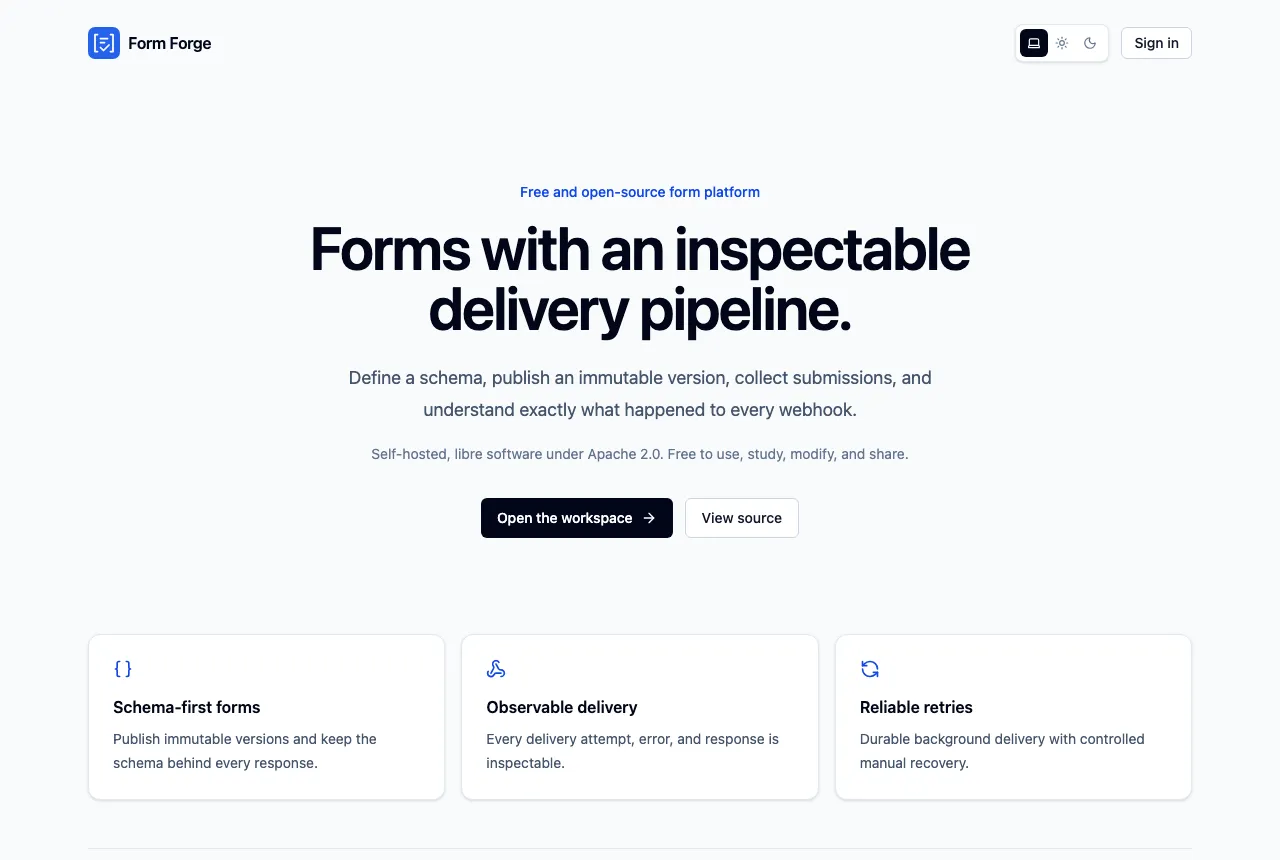
Eine selbst gehostete Formularplattform mit nachvollziehbarer Zustellung. Eigenen Formulardienst betreiben: versionierte Formulare veröffentlichen, Antworten in PostgreSQL sammeln und an signierte Webhooks liefern.
- Version
- v0.2.0, 18. Okt. 2026
- Läuft auf
- Selbst gehostet: Node.js, PostgreSQL, Inngest; Docker Compose oder Netlify
- Lizenz
- Apache-2.0
Öffentliche Instanz öffnen: Anmeldung mit GitHub, Google oder GitLab nötig. Für sie ist kein Service-Level veröffentlicht.
Die folgende Projektbeschreibung ist auf Englisch.
So sieht es aus
pnpm install
cp apps/web/.env.example apps/web/.env
pnpm db:migrate
pnpm devWas es tut
Define a form as a schema, publish an immutable version, and collect responses through a hosted page, an embedded iframe or the public API. Every webhook delivery is signed and recorded with its attempts and errors, so you can see what happened to each response. Data stays in your PostgreSQL database.
Für wen
- Teams that want forms on their own infrastructure instead of a SaaS form builder.
- Developers who need reliable webhook delivery with retries and diagnostics.
Einschränkungen
- Not a hosted SaaS: you operate PostgreSQL, the web app and the background-job server.
- Sign-in uses GitHub, Google or GitLab OAuth; there are no email and password accounts.
- Unfinished responses are not collected, and workspace packages are not published to npm.
Typische Einsätze
Collect sign-ups on your site
Embed a published form with automatic height, or post to the idempotent submission API from your own frontend.
Feed another system
Each response goes to a signed webhook through a transactional outbox with automatic retries and manual recovery.
Close intake on time
Pause a form, set a closing time or an acceptance limit, and show a custom closed message.
Herunterladen
Neueste stabile Version v0.2.0, veröffentlicht am 18. Okt. 2026. Versionshinweise zu v0.2.0. Versionsdaten am 31. Okt. 2026 aus GitHub Releases abgerufen.
Jede Plattform
Verfügbare Dateien (1)
- Quellcodearchiv des Release (.tar.gz), Jede Plattform Quellcode · Quellcode · 371 kB · Paket
Extract and follow the getting-started guide.
Die Installationsschritte sind auf Englisch.
Download prüfen
SHA256SUMS enthält SHA-256-Hashes der Release-Dateien. Stimmt der Hash überein, ist Ihre Datei identisch mit der veröffentlichten. Das ist eine Prüfsumme, keine Signatur des Autors: Sie belegt nicht, wer die Datei gebaut hat.
shasum -a 256 -c --ignore-missing SHA256SUMSErster Start
Install Node.js (22.22.2+, 24.15.0+ or 26+), pnpm 12.10.1 and PostgreSQL, and create a GitHub OAuth app.
Clone the repository, configure apps/web/.env, run the migrations and start the app:
pnpm install
pnpm db:migrate
pnpm dev
Start the local background-job server in another terminal:
npx --ignore-scripts=false inngest-cli@latest dev -u http://localhost:3000/api/inngestOpen localhost:3000, create a form, publish it and submit a test response.
Plattformen und wie sie geprüft wurden
- Self-hosted with Docker ComposeUnterstützung angegeben, keine Laufzeitprüfung
Production guide in deploy/README.md.
- NetlifyIm Betrieb geprüft
The public deployment linked from the repository runs on Netlify.
- RespondentsUnterstützung angegeben, keine Laufzeitprüfung
Hosted and embedded forms open in a modern web browser.
Dokumentation und Support
Fragen und Fehlerberichte gehören in den Issue-Tracker des Projekts. Sicherheitsprobleme melden Sie wie in seiner Sicherheitsrichtlinie beschrieben.