
Devices and networks
SpaceMosaic
A read-only storage map for one folder at a time. Find out what takes up space in a folder with a size map, without deleting or changing anything.
- Release
- v0.1.2, Oct 29, 2026
- Runs on
- Desktop app; Android 8.0+ APK; iOS requires your own signing
- License
- Apache-2.0
What it looks like
What it does
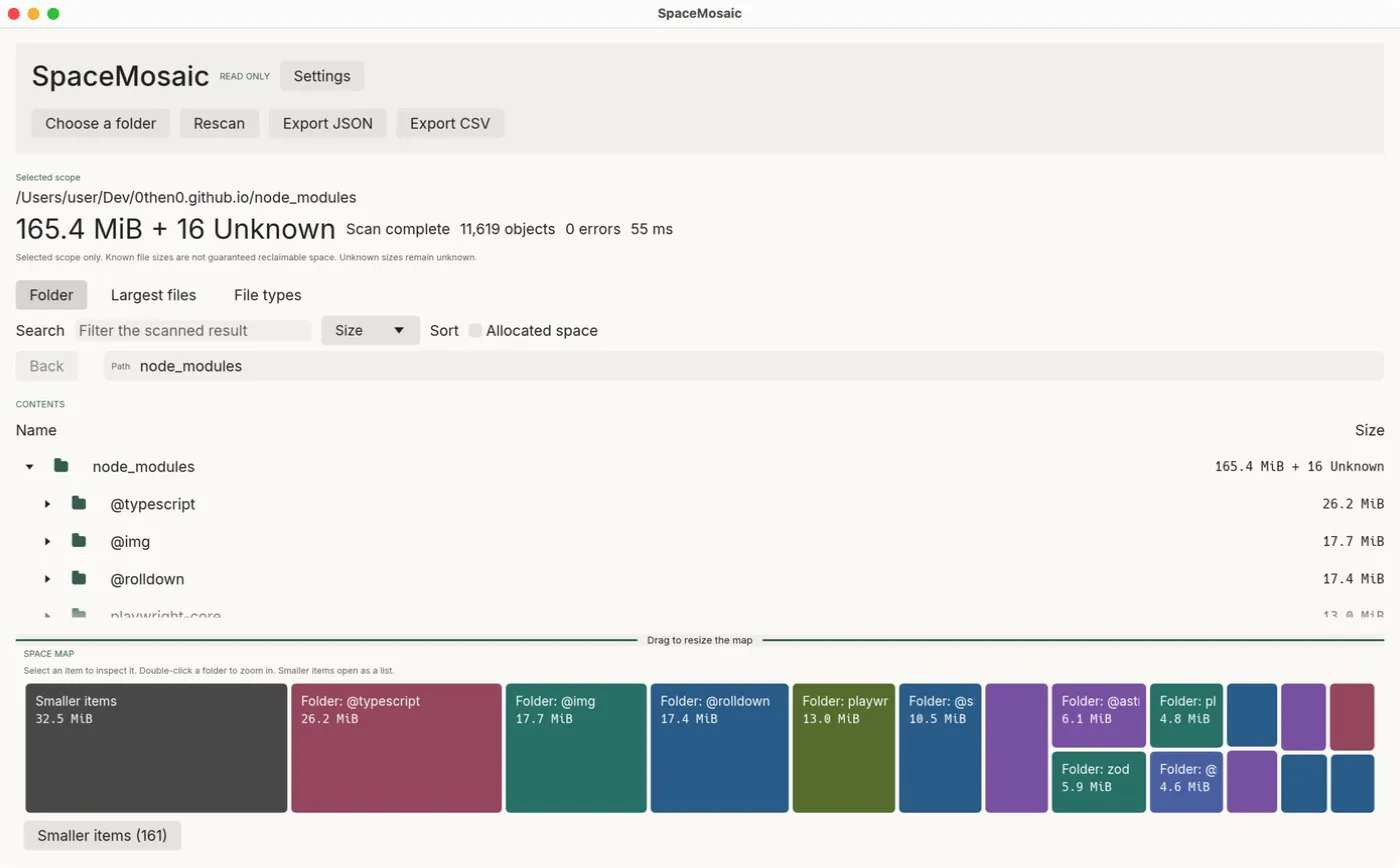
Choose a folder and SpaceMosaic shows how its size is distributed: a tree, a treemap, the largest files and a file-type summary. It reads file metadata only, never file contents, and has no delete or cleanup actions, so exploring cannot cause damage.
Who it is for
- People whose disk is filling up and who want to see which folders are responsible before deciding what to remove.
- Anyone who needs a size report for a folder, exported as JSON or CSV.
- Users who distrust cleanup tools: there is nothing to click that removes files.
Limitations
- It measures the selected folder, not the whole disk, and a size is not a promise of reclaimable space (hard links, APFS clones and compression).
- Desktop scans stop at 500,000 objects or about 256 MiB of metadata; mobile at 100,000 objects. The result is then marked partial.
- Windows and macOS builds are not signed with a publisher certificate; macOS is ad-hoc signed and not notarized.
- Symbolic links and Windows reparse points are not followed.
Typical uses
Find the heavy folders
Scan a project, Downloads or a media folder and follow the largest tiles down the map. Double-click a folder to zoom in; small items are grouped into a searchable list.
Unknown stays unknown
Unreadable folders and unknown sizes are marked as Unknown instead of 0 B. Logical size and allocated space are shown separately, and a partial scan says why it is partial.
Share a report
Export the result as versioned JSON or a CSV file-type summary. Exports contain file names and paths, so review them before sharing.
Download
Latest stable release v0.1.2, published Oct 29, 2026. Release notes for v0.1.2. Release data checked Oct 31, 2026 from GitHub Releases.
macOS
- Open the DMG and drag SpaceMosaic.app to Applications.
- If macOS blocks the first launch, approve it in System Settings → Privacy & Security.
Other formats (1)
- ZIP archive, macOS Apple Silicon (arm64) · Apple Silicon (arm64) · 9.7 MB · Ad-hoc signed, not notarized
Extract and open spacemosaic-darwin-arm64/SpaceMosaic.app.
Windows
- Run the installer. It installs for the current user without administrator rights.
- Windows may warn about an unrecognised app because the installer has no Authenticode signature.
Other formats (1)
- Portable ZIP, Windows x86-64 · x86-64 · 9.5 MB · Unsigned
Extract the complete archive and run spacemosaic.exe.
Linux
- Install with apt so dependencies are resolved: sudo apt install ./spacemosaic-linux-x86_64.deb
Other formats (1)
- Portable archive (.tar.gz), Linux x86-64 · x86-64 · 12 MB · Unsigned
Extract and run spacemosaic. Compatible system libraries are required.
Android
- Allow installation from your browser or file manager, then open the APK.
- If you installed an alpha.2 or alpha.3 debug APK before, uninstall it first: the signing certificates differ.
iOS
Not available as a regular install. Only these builds are published for iOS:
spacemosaic-device.zip: Requires your own signing and provisioning. Not an installable IPA. Sign it in Xcode with your own development team.spacemosaic-simulator.zip: Simulator only, not for devices. For the iOS Simulator on an Apple Silicon Mac only.
Developers can find them on the release page or build from source.
iOS builds are published for developers only: the device build must be signed in Xcode, and the simulator build cannot run on an iPhone.
Verify a download
SHA256SUMS lists SHA-256 hashes for the release files. A matching hash shows that your file is identical to the one uploaded with the release. It is a checksum, not a signature from the author: it does not prove who built the file.
shasum -a 256 -c --ignore-missing SHA256SUMSFirst run
Install the build for your system from the download section.
On macOS, the first launch may be blocked because the app is not notarized. Approve it in System Settings → Privacy & Security.
Choose a folder with the button, drag one into the window, or pass a path on the command line:
spacemosaic /path/to/folderFollow the largest tiles. Select a tile to see its details, or open Largest files and File types.
Platforms and how they were checked
- macOS, Apple SiliconVerified running
The desktop app runs on macOS arm64. There is no Intel build.
- Android 8.0+Tested by a user on one device
Reported as relatively stable on a Pixel 8 with Android 17. In-place upgrades, screen readers and every storage provider are not verified.
- Windows x86-64Builds and passes automated checks in CI
Builds in CI. An earlier alpha was tried on Windows 11; later fixes still need revalidation there.
- Linux x86-64Builds and passes automated checks in CI
Built on Ubuntu 24.04. Portable archives still need compatible system libraries.
- iOS 16+Builds and passes automated checks in CI
Unsigned device build and simulator build only. Installing on an iPhone requires Xcode, a development team and signing.
Documentation and support
Questions and bug reports go to the project’s issue tracker. Report security problems as described in its security policy.